
Start Herkimer County deed records with the instrument type
The County Clerk keeps Herkimer County deed records. SearchIQS indexes far more than deeds there. Mortgages, assignments, satisfactions, liens, releases, easements, leases, and filed maps all sit in the same system. Start your deed search with the current grantee listed on the assessment roll, then locate the newest deed that plausibly covers the parcel. Read its legal description before stepping back another generation. Be careful with name matches alone. Trusts, entities, spelling variants, and shared family names appear again and again in Herkimer County property records, so a matching name is only the beginning of the trail.
| Instrument | What it may establish | What to inspect |
|---|---|---|
| Deed | Recorded conveyance | Grantor, grantee, description, recording |
| Mortgage | Recorded security interest | Borrower, lender, amount, property |
| Assignment | Transfer of an interest | Prior reference and assignee |
| Satisfaction | Recorded discharge | Mortgage reference and parties |
| Map or easement | Parcel or use-right context | Lots, dimensions, affected land |
SearchIQS access for Herkimer County deeds
The public entry screen offers guest search alongside account, subscription, and password controls. Detailed record forms only open after entry, so plan on building from the index first. Indexing information stays free. Images cost extra, a split in effect since March 1, 2025. Sketch your candidate chain of deeds from the index. Then pay only for the images you actually need to test that chain. The official access screen shown here separates guest entry from subscriber tools.
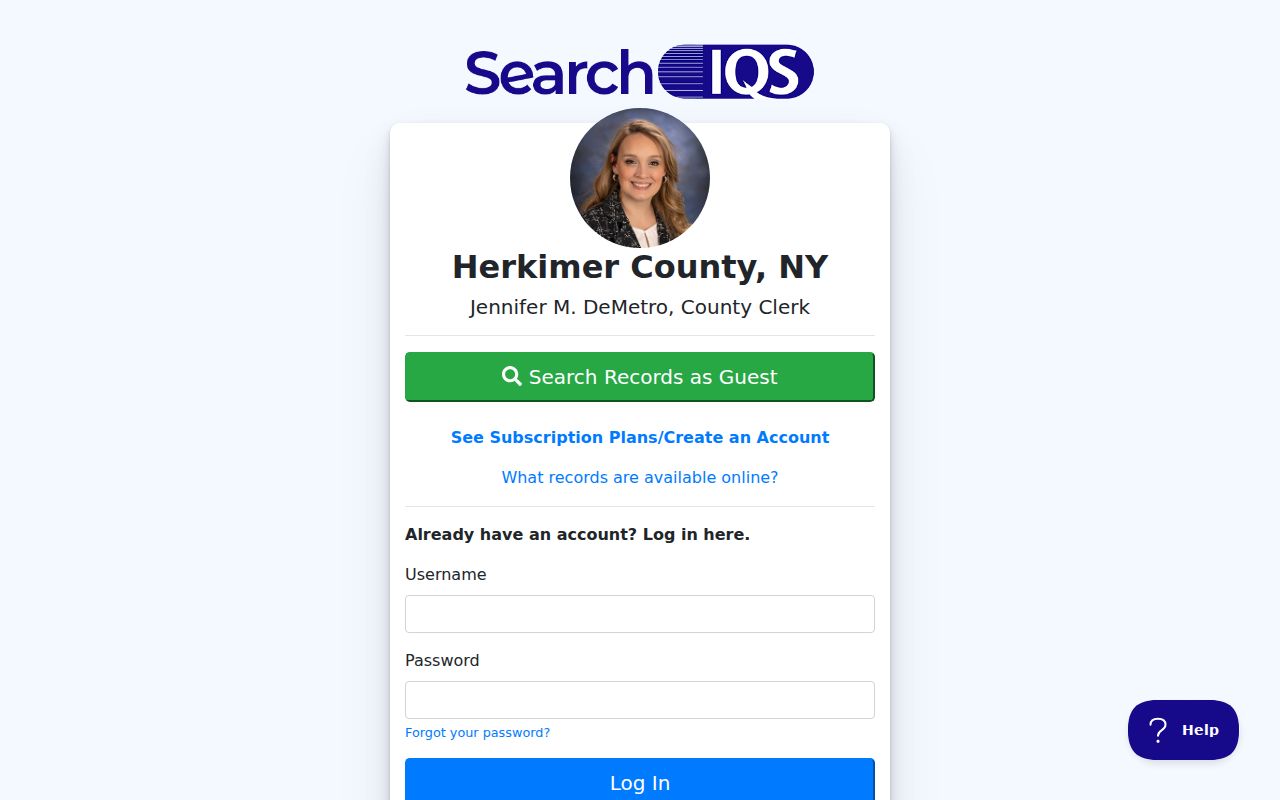
The screen itself proves nothing about ownership. Ownership conclusions come from the indexed instruments and the deed text behind them.
Read a Herkimer County deed as a linked record
Pull these details from every Herkimer County deed you read: grantor, grantee, deed type, execution or acknowledgment date, recording date, stated consideration, book and page or document number, tax map reference. Also note the full legal description. Then run a two-date check. Compare the earlier transaction date against the assessment status date. Compare the later recording date against the next tax roll. That comparison often explains why a buyer shows up in one Herkimer County source before appearing in another.
Grantor: the party conveying the parcel. Grantee: the party receiving it. Chain of title: the linked sequence of conveyances. Index: a finding aid, never the complete instrument.
Follow mortgages through assignment and discharge
A recorded mortgage proves a loan once existed, not a balance still owed today. Search assignments and satisfactions by party name and by recording reference. Older related-record display is not guaranteed. Chase any missing satisfaction with its own name search. Treat UCC filings carefully too. They can cover personal property or fixtures rather than a lien on fee title. Herkimer County's county mortgage recording tax authority was extended by Chapter 221. It was signed August 7, 2025, through December 1, 2027. That extension says nothing about what a specific recording costs. Confirm how the tax applies with the Clerk at filing time.
Use maps and legal descriptions to distinguish similar names
Lot, block, subdivision, metes-and-bounds calls, adjoining owners, easements, and prior deed references are what make a parcel identifiable. Check them against the current tax map and any filed maps. An assessment polygon is not a survey. Near Little Falls, canal, river, rail, island, and industrial names may all overlap in the records. Tie every description to its source and date. The County Clerk landing page below is the official starting point for recording and public research.

The page also explains fraud alerts and current image-access policy.
Obtain copies and monitor later filings
A plain copy serves ordinary genealogy and title research. A certified copy comes from the custodian for purposes requiring certification. Ask the Clerk about current charges. Published fee schedules carry dates, and online image plans can shift. The free fraud-alert form takes an email and up to three names. After confirmation, it sends notice of future matching filings. Pick spellings the index is likely to use, including any authorized entity or trust name.
Recorded does not mean verified title. Herkimer County deed records must be read as a chain, with legal descriptions and intervening instruments checked.
Herkimer County Deed Records and What They Show
| Deed Type | What It Does | Common Use |
|---|---|---|
| Warranty deed | ||
| Quitclaim deed | ||
| Grant / special warranty | ||
| Trustee / executor deed | ||
| Tax deed |
The Herkimer County Grantor-Grantee Index
- Grantor
- Grantee
- Chain of title
- Book/Page vs Instrument #
Getting a Copy of a Herkimer County Deed
Recorded, not guaranteed.
Trace older Herkimer County deeds beyond online coverage
Online indexes stop somewhere. When yours does, write down the last verified grantor, grantee, date, book and page, map reference, and legal description. Take those details to the County Clerk's public research facilities and keep going through older deed books, reverse indexes, or microfilm. Work backward from a known conveyance. A broad surname sweep wastes time. The Herkimer County Historical Society can decode older street wording through directories, atlases, maps, newspapers, census sources, cemetery records, and will holdings. Those sources surface promising names and places. They are no substitute for the recorded deed. Return every lead to the Clerk chain, compare the legal description, and only then call someone a prior owner of record.
Prepare a precise Herkimer County deed copy request
Give the Clerk everything you already hold: document type, grantor and grantee. Add the recording date, book and page or document number, and any map reference. Say whether you want a plain or certified copy. Confirm current fees, because published schedules date quickly and online image plans can change. Starting from just a street address? Recover the tax map number and current owner of record from the roll first. The Clerk index runs on recorded parties and instruments. So a normalized name plus a recording period beats an unsupported street guess every time. File the request and the response with your chain notes.
Read Herkimer County foreclosure documents in sequence
A lis pendens only gives notice of litigation; it conveys nothing. The complaint, judgment, auction result, and referee deed are separate records in the sequence. Before reporting that ownership changed, capture the court index number, parties, property description, judgment or disposition, and the final recorded deed. Tax auctions follow the same order, with the catalog and winning bid recorded ahead of the deed itself. eCourts and NYSCEF offer starting points, though restricted, older, or non-electronic material may still require a courthouse trip. A docket is not the whole file. Close the loop by joining the court result to the County Clerk instrument and the next assessment roll.
Distinguish recorded liens from ownership transfers
Liens and ownership transfers are not the same thing. A mortgage, judgment, tax lien, or UCC filing can shape a Herkimer County deed search. But it does not name a new fee owner. For each one, record the debtor or borrower. Also note the creditor, the filing date, and any amount shown. Note the affected property too. Check for a later release or satisfaction, since that closes the loop on the encumbrance. When the portal does not link older records automatically, search for related instruments on their own.
Never call an indexed obligation unpaid without current evidence. A UCC filing may cover personal property or fixtures rather than fee title. Keep the deed chain and the encumbrance timeline parallel in your notes. Where legal effect matters, a qualified title professional should weigh in.
Keep an evidence log for Herkimer County deeds
An evidence log keeps a Herkimer County deed search honest. For every candidate instrument, record the index category, the exact party spelling, and the recording date. Also record the document or book-and-page reference. Add the municipality and the tax map number when one is shown. Track whether you reviewed the image and when you retrieved it. Write down why each item was included or rejected. That discipline keeps a same-name deed out of the chain when the property description does not match. It also makes paid image purchases easier to justify.
Use plain labels: index only, image reviewed, filed map reviewed, historic lead. If no deed turns up, state the source, category, party, date range, and access limit. A documented negative search carries weight. A bare claim that no deed exists does not.